
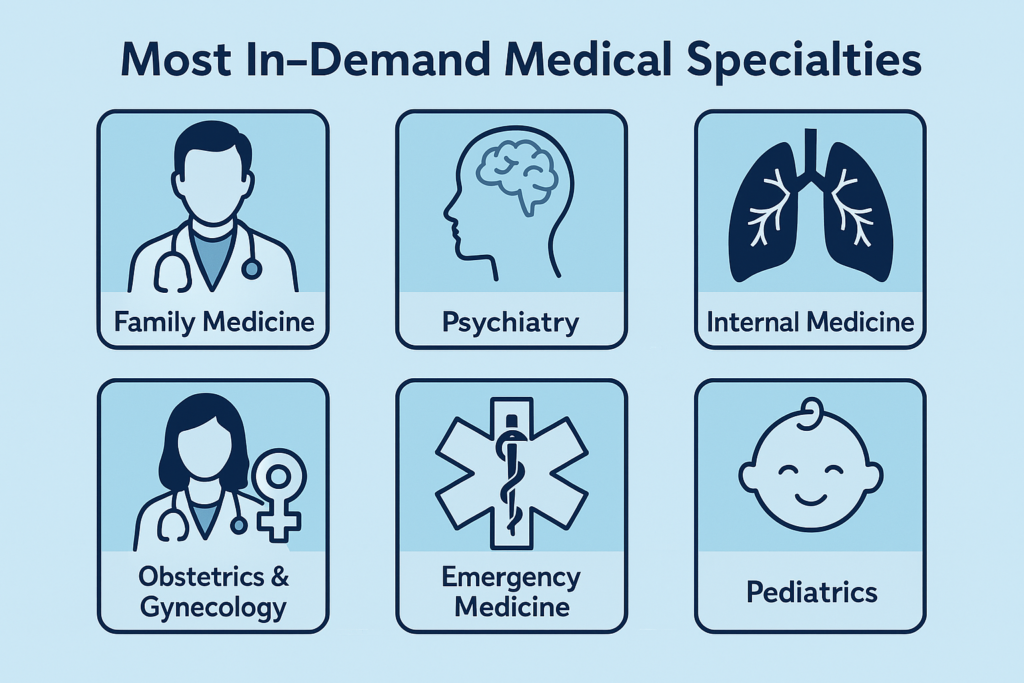
Switzerland remains one of the most attractive destinations in Europe for healthcare professionals. In 2026, demand for doctors continues to grow due to an ageing population, the retirement of many specialists, and a lack of generational replacement. In fact, the Swiss Medical Association (FMH) has recently warned of a growing shortage of specialist doctors across the country.
For foreign physicians, especially those coming from Spain and other European countries, this represents a real professional opportunity. However, not all specialties are equally in demand. Some fields offer significantly more vacancies and stronger career prospects.
Family Medicine: The Specialty with the Highest Demand in Switzerland
Family medicine remains one of the most sought-after areas in Switzerland. Many primary care physicians are approaching retirement, particularly in rural areas and smaller towns, where finding replacements has become increasingly difficult.
As a result, many medical centres and private practices are actively recruiting new professionals. For doctors specialised in family and community medicine, this is one of the fastest routes into the Swiss labour market, especially with a good command of German or French.
It is also a highly valued specialty within the Swiss healthcare system, as general practitioners play a key role in patient coordination and overall healthcare efficiency.
Psychiatry and Mental Health: Growing Demand
Mental health has gained enormous relevance in recent years, and Switzerland is no exception. Demand for psychiatrists, both for adults and child/adolescent patients, continues to rise in hospitals, private clinics, and outpatient centres.
Access to psychological and psychiatric care has become a growing priority, creating stable opportunities for doctors in this specialty. Professionals with previous experience and the ability to integrate linguistically often secure very attractive working conditions.
Internal Medicine and Geriatrics: The Impact of an Ageing Population
Like many European countries, Switzerland has an increasingly ageing population. This raises demand for specialists capable of managing chronic illnesses, multi-morbid patients, and complex age-related health conditions.
For this reason, internal medicine and geriatrics will remain two specialties with strong employability in 2026. Regional hospitals, care centres, and long-term care units are actively seeking doctors trained in these disciplines.
Paediatrics: Consistent Opportunities in Primary Care and Hospitals
Paediatrics continues to enjoy solid demand in Switzerland. Both private practices and regional hospitals require new specialists, particularly in growing urban and suburban areas.
For many foreign doctors, paediatrics represents an excellent opportunity, combining strong career prospects with a highly respected clinical role within the Swiss healthcare system.
Anaesthesiology: High Employability and Excellent Conditions
Anaesthesiology remains a strategic specialty for both public and private hospitals. Difficulty filling certain vacancies, together with the constant need for surgical activity, keeps demand high.
Anaesthesiologists often benefit from competitive salaries and attractive working conditions, particularly in medium-sized hospitals and cantons with lower local availability of professionals.
Radiology: Growth Driven by Technology
The increase in diagnostic imaging and the modernisation of the healthcare system have reinforced the need for radiologists in Switzerland. Specialists in MRI, CT scanning, and interventional radiology are especially attractive.
Digitalisation has also opened new opportunities in telemedicine and teleradiology, allowing increasingly flexible working models.
Emergency Medicine: Constant Need
Emergency departments continue to require doctors who can work under pressure and make quick decisions. Both major hospitals and regional centres need to strengthen their teams, particularly for shift coverage, acute medicine, and ongoing emergency care.
For doctors with previous hospital experience, this can be an excellent gateway into the Swiss labour market.
What Language Do You Need to Work as a Doctor in Switzerland?
One of the key factors for practising medicine in Switzerland is language. Depending on the region, German, French, or Italian is required, usually at a minimum B2 level and often C1 for clinical positions.
In German-speaking Switzerland, which concentrates a large share of vacancies, speaking German significantly increases professional opportunities.
Is It a Good Time to Move to Switzerland?
Yes, especially for doctors with recognised specialist qualifications and strong language skills. The Swiss healthcare system relies heavily on foreign professionals, and this trend is expected to continue in the coming years.
The best opportunities will be in family medicine, psychiatry, internal medicine, geriatrics, anaesthesiology, radiology, and paediatrics. For those seeking better financial conditions, stability, and international career growth, Switzerland remains one of Europe’s most attractive markets.
Conclusion
Working as a doctor in Switzerland is an especially attractive option for professionals in high-demand specialties. The shortage of medical staff in several areas, combined with the country’s strong economy, will continue to generate real opportunities.
If you are considering making the move, it is advisable to prepare in advance regarding degree recognition, language requirements, and a job search strategy adapted to the Swiss market. Being well prepared makes all the difference.
At Go Swiss Talent, we support you throughout the entire process to make the transition much easier: from degree recognition and documentation preparation to career guidance, CV optimisation, and helping you find opportunities suited to your professional profile in Switzerland.
